Optimal Transition-based Rapidly-exploring Random Trees. More...
#include <ompl/geometric/planners/rrt/TRRTstar.h>
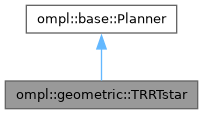
Classes | |
| class | Motion |
| Representation of a motion. More... | |
| struct | CostIndexCompare |
Public Member Functions | |
| TRRTstar (const base::SpaceInformationPtr &si) | |
| void | getPlannerData (base::PlannerData &data) const override |
| Get information about the current run of the motion planner. Repeated calls to this function will update data (only additions are made). This is useful to see what changed in the exploration datastructure, between calls to solve(), for example (without calling clear() in between). | |
| base::PlannerStatus | solve (const base::PlannerTerminationCondition &ptc) override |
| Function that can solve the motion planning problem. This function can be called multiple times on the same problem, without calling clear() in between. This allows the planner to continue work for more time on an unsolved problem, for example. If this option is used, it is assumed the problem definition is not changed (unpredictable results otherwise). The only change in the problem definition that is accounted for is the addition of starting or goal states (but not changing previously added start/goal states). If clearQuery() is called, the planner may retain prior datastructures generated from a previous query on a new problem definition. The function terminates if the call to ptc returns true. | |
| void | clear () override |
| Clear all internal datastructures. Planner settings are not affected. Subsequent calls to solve() will ignore all previous work. | |
| void | setup () override |
| Perform extra configuration steps, if needed. This call will also issue a call to ompl::base::SpaceInformation::setup() if needed. This must be called before solving. | |
| void | setGoalBias (double goalBias) |
| Set the goal bias. | |
| double | getGoalBias () const |
| Get the goal bias the planner is using. | |
| void | setRange (double distance) |
| Set the range the planner is supposed to use. | |
| double | getRange () const |
| Get the range the planner is using. | |
| void | setRewireFactor (double rewireFactor) |
| Set the rewiring scale factor, s, such that r_rrg = s \times r_rrg* (or k_rrg = s \times k_rrg*). | |
| double | getRewireFactor () const |
| Set the rewiring scale factor, s, such that r_rrg = s \times r_rrg* > r_rrg* (or k_rrg = s \times k_rrg* > k_rrg*). | |
| template<template< typename T > class NN> | |
| void | setNearestNeighbors () |
| Set a different nearest neighbors datastructure. | |
| void | setDelayCC (bool delayCC) |
| Option that delays collision checking procedures. When it is enabled, all neighbors are sorted by cost. The planner then goes through this list, starting with the lowest cost, checking for collisions in order to find a parent. The planner stops iterating through the list when a collision free parent is found. This prevents the planner from collision checking each neighbor, reducing computation time in scenarios where collision checking procedures are expensive. | |
| bool | getDelayCC () const |
| Get the state of the delayed collision checking option. | |
| void | setTreePruning (bool prune) |
| Controls whether the tree is pruned during the search. This pruning removes a vertex if and only if it and all its descendents passes the pruning condition. The pruning condition is whether the lower-bounding estimate of a solution constrained to pass the the vertex is greater than the current solution. Considering the descendents of a vertex prevents removing a descendent that may actually be capable of later providing a better solution once its incoming path passes through a different vertex (e.g., a change in homotopy class). | |
| bool | getTreePruning () const |
| Get the state of the pruning option. | |
| void | setPruneThreshold (const double pp) |
| Set the fractional change in solution cost necessary for pruning to occur, i.e., prune if the new solution is at least X% better than the old solution. (e.g., 0.0 will prune after every new solution, while 1.0 will never prune.). | |
| double | getPruneThreshold () const |
| Get the current prune states percentage threshold parameter. | |
| void | setAdmissibleCostToCome (const bool admissible) |
| Controls whether pruning and new-state rejection uses an admissible cost-to-come estimate or not. | |
| bool | getAdmissibleCostToCome () const |
| Get the admissibility of the pruning and new-state rejection heuristic. | |
| void | setBatchSize (unsigned int batchSize) |
| Set the batch size used for sample ordering. | |
| unsigned int | getBatchSize () const |
| Get the batch size used for sample ordering. | |
| void | setKNearest (bool useKNearest) |
| Use a k-nearest search for rewiring instead of a r-disc search. | |
| bool | getKNearest () const |
| Get the state of using a k-nearest search for rewiring. | |
| void | setNumSamplingAttempts (unsigned int numAttempts) |
| Set the number of attempts to make while performing rejection or informed sampling. | |
| unsigned int | getNumSamplingAttempts () const |
| Get the number of attempts to make while performing rejection or informed sampling. | |
| unsigned int | numIterations () const |
| ompl::base::Cost | bestCost () const |
| void | setTempChangeFactor (double factor) |
| Set the factor by which the temperature is increased after a failed transition test. This value should be in the range (0, 1], typically close to zero (default is 0.1). This value is an exponential (e^factor) that is multiplied with the current temperature. | |
| double | getTempChangeFactor () const |
| Get the factor by which the temperature rises based on current acceptance/rejection rate. | |
| void | setCostThreshold (double maxCost) |
| Set the cost threshold (default is infinity). Any motion cost that is not better than this cost (according to the optimization objective) will not be expanded by the planner. | |
| double | getCostThreshold () const |
| Get the cost threshold (default is infinity). Any motion cost that is not better than this cost (according to the optimization objective) will not be expanded by the planner. | |
| void | setInitTemperature (double initTemperature) |
| Set the initial temperature at the beginning of the algorithm. Should be high to allow for initial exploration. | |
| double | getInitTemperature () const |
| Get the temperature at the start of planning. | |
| Public Member Functions inherited from ompl::base::Planner | |
| Planner (const Planner &)=delete | |
| Planner & | operator= (const Planner &)=delete |
| Planner (SpaceInformationPtr si, std::string name) | |
| Constructor. | |
| virtual | ~Planner ()=default |
| Destructor. | |
| template<class T> | |
| T * | as () |
| Cast this instance to a desired type. | |
| template<class T> | |
| const T * | as () const |
| Cast this instance to a desired type. | |
| const SpaceInformationPtr & | getSpaceInformation () const |
| Get the space information this planner is using. | |
| const ProblemDefinitionPtr & | getProblemDefinition () const |
| Get the problem definition the planner is trying to solve. | |
| ProblemDefinitionPtr & | getProblemDefinition () |
| Get the problem definition the planner is trying to solve. | |
| const PlannerInputStates & | getPlannerInputStates () const |
| Get the planner input states. | |
| virtual void | setProblemDefinition (const ProblemDefinitionPtr &pdef) |
| Set the problem definition for the planner. The problem needs to be set before calling solve(). Note: If this problem definition replaces a previous one, it may also be necessary to call clear() or clearQuery(). | |
| PlannerStatus | solve (const PlannerTerminationConditionFn &ptc, double checkInterval) |
| Same as above except the termination condition is only evaluated at a specified interval. | |
| PlannerStatus | solve (double solveTime) |
| Same as above except the termination condition is solely a time limit: the number of seconds the algorithm is allowed to spend planning. | |
| virtual void | clearQuery () |
| Clears internal datastructures of any query-specific information from the previous query. Planner settings are not affected. The planner, if able, should retain all datastructures generated from previous queries that can be used to help solve the next query. Note that clear() should also clear all query-specific information along with all other datastructures in the planner. By default clearQuery() calls clear(). | |
| const std::string & | getName () const |
| Get the name of the planner. | |
| void | setName (const std::string &name) |
| Set the name of the planner. | |
| const PlannerSpecs & | getSpecs () const |
| Return the specifications (capabilities of this planner). | |
| virtual void | checkValidity () |
| Check to see if the planner is in a working state (setup has been called, a goal was set, the input states seem to be in order). In case of error, this function throws an exception. | |
| bool | isSetup () const |
| Check if setup() was called for this planner. | |
| ParamSet & | params () |
| Get the parameters for this planner. | |
| const ParamSet & | params () const |
| Get the parameters for this planner. | |
| const PlannerProgressProperties & | getPlannerProgressProperties () const |
| Retrieve a planner's planner progress property map. | |
| virtual void | printProperties (std::ostream &out) const |
| Print properties of the motion planner. | |
| virtual void | printSettings (std::ostream &out) const |
| Print information about the motion planner's settings. | |
Protected Member Functions | |
| void | allocSampler () |
| Create the samplers. | |
| bool | sampleUniform (base::State *statePtr) |
| Generate a sample. | |
| void | freeMemory () |
| Free the memory allocated by this planner. | |
| double | distanceFunction (const Motion *a, const Motion *b) const |
| Compute distance between motions (actually distance between contained states). | |
| bool | transitionTest (const base::Cost &motionCost) |
| Filter irrelevant configuration regarding the search of low-cost paths before inserting into tree. | |
| void | getNeighbors (Motion *motion, std::vector< Motion * > &nbh) const |
| Gets the neighbours of a given motion, using either k-nearest of radius as appropriate. | |
| void | removeFromParent (Motion *m) |
| Removes the given motion from the parent's child list. | |
| void | updateChildCosts (Motion *m) |
| Updates the cost of the children of this node if the cost up to this node has changed. | |
| int | pruneTree (const base::Cost &pruneTreeCost) |
| Prunes all those states which estimated total cost is higher than pruneTreeCost. Returns the number of motions pruned. Depends on the parameter set by setPruneStatesImprovementThreshold(). | |
| base::Cost | solutionHeuristic (const Motion *motion) const |
| Computes the solution cost heuristically as the cost to come from start to the motion plus the cost to go from the motion to the goal. If the parameter use_admissible_heuristic (setAdmissibleCostToCome()) is true, a heuristic estimate of the cost to come is used; otherwise, the current cost to come to the motion is used (which may overestimate the cost through the motion). | |
| void | addChildrenToList (std::queue< Motion *, std::deque< Motion * > > *motionList, Motion *motion) |
| Add the children of a vertex to the given list. | |
| bool | keepCondition (const Motion *motion, const base::Cost &threshold) const |
| Check whether the given motion passes the specified cost threshold, meaning it will be kept during pruning. | |
| void | calculateRewiringLowerBounds () |
| Calculate the k_RRG* and r_RRG* terms. | |
| std::string | numIterationsProperty () const |
| std::string | bestCostProperty () const |
| Protected Member Functions inherited from ompl::base::Planner | |
| template<typename T, typename PlannerType, typename SetterType, typename GetterType> | |
| void | declareParam (const std::string &name, const PlannerType &planner, const SetterType &setter, const GetterType &getter, const std::string &rangeSuggestion="") |
| This function declares a parameter for this planner instance, and specifies the setter and getter functions. | |
| template<typename T, typename PlannerType, typename SetterType> | |
| void | declareParam (const std::string &name, const PlannerType &planner, const SetterType &setter, const std::string &rangeSuggestion="") |
| This function declares a parameter for this planner instance, and specifies the setter function. | |
| void | addPlannerProgressProperty (const std::string &progressPropertyName, const PlannerProgressProperty &prop) |
| Add a planner progress property called progressPropertyName with a property querying function prop to this planner's progress property map. | |
Protected Attributes | |
| base::StateSamplerPtr | sampler_ |
| State sampler. | |
| base::InformedSamplerPtr | infSampler_ |
| An informed sampler. | |
| std::shared_ptr< NearestNeighbors< Motion * > > | nn_ |
| A nearest-neighbors datastructure containing the tree of motions. | |
| double | goalBias_ {.05} |
| The fraction of time the goal is picked as the state to expand towards (if such a state is available). | |
| double | maxDistance_ {0.} |
| The maximum length of a motion to be added to a tree. | |
| RNG | rng_ |
| The random number generator. | |
| bool | useKNearest_ {true} |
| Option to use k-nearest search for rewiring. | |
| double | rewireFactor_ {1.1} |
| The rewiring factor, s, so that r_rrt = s \times r_rrt* > r_rrt* (or k_rrt = s \times k_rrt* > k_rrt*). | |
| double | k_rrt_ {0u} |
| A constant for k-nearest rewiring calculations. | |
| double | r_rrt_ {0.} |
| A constant for r-disc rewiring calculations. | |
| bool | delayCC_ {true} |
| Option to delay and reduce collision checking within iterations. | |
| base::OptimizationObjectivePtr | opt_ |
| Objective we're optimizing. | |
| Motion * | bestGoalMotion_ {nullptr} |
| The best goal motion. | |
| std::vector< Motion * > | goalMotions_ |
| A list of states in the tree that satisfy the goal condition. | |
| bool | useTreePruning_ {false} |
| The status of the tree pruning option. | |
| double | pruneThreshold_ {.05} |
| The tree is pruned when the change in solution cost is greater than this fraction. | |
| bool | useAdmissibleCostToCome_ {true} |
| The admissibility of the new-state rejection heuristic. | |
| unsigned int | numSampleAttempts_ {100u} |
| The number of attempts to make at informed sampling. | |
| unsigned int | batchSize_ {1u} |
| The size of the batches. | |
| std::vector< Motion * > | startMotions_ |
| Stores the start states as Motions. | |
| base::Cost | bestCost_ {std::numeric_limits<double>::quiet_NaN()} |
| Best cost found so far by algorithm. | |
| base::Cost | prunedCost_ {std::numeric_limits<double>::quiet_NaN()} |
| The cost at which the graph was last pruned. | |
| double | prunedMeasure_ {0.} |
| The measure of the problem when we pruned it (if this isn't in use, it will be set to si_->getSpaceMeasure()). | |
| unsigned int | iterations_ {0u} |
| Number of iterations the algorithm performed. | |
| double | temp_ |
| Temperature parameter used to control the difficulty level of transition tests. Low temperatures limit the expansion to a slightly positive slopes, high temps enable to climb the steeper slopes. Dynamically tuned according to the information acquired during exploration. | |
| base::Cost | worstCost_ {base::Cost(std::numeric_limits<double>::infinity())} |
| The least desirable (e.g., maximum) cost value in the search tree. | |
| base::Cost | costThreshold_ {base::Cost(std::numeric_limits<double>::infinity())} |
| All motion costs must be better than this cost (default is infinity). | |
| double | tempChangeFactor_ {.1} |
| The value of the expression exp^T_rate. The temperature is increased by this factor whenever the transition test fails. | |
| double | initTemperature_ {100.0} |
| The initial value of temp_. | |
| Protected Attributes inherited from ompl::base::Planner | |
| SpaceInformationPtr | si_ |
| The space information for which planning is done. | |
| ProblemDefinitionPtr | pdef_ |
| The user set problem definition. | |
| PlannerInputStates | pis_ |
| Utility class to extract valid input states. | |
| std::string | name_ |
| The name of this planner. | |
| PlannerSpecs | specs_ |
| The specifications of the planner (its capabilities). | |
| ParamSet | params_ |
| A map from parameter names to parameter instances for this planner. This field is populated by the declareParam() function. | |
| PlannerProgressProperties | plannerProgressProperties_ |
| A mapping between this planner's progress property names and the functions used for querying those progress properties. | |
| bool | setup_ |
| Flag indicating whether setup() has been called. | |
Additional Inherited Members | |
| Public Types inherited from ompl::base::Planner | |
| using | PlannerProgressProperty = std::function<std::string()> |
| Definition of a function which returns a property about the planner's progress that can be queried by a benchmarking routine. | |
| using | PlannerProgressProperties = std::map<std::string, PlannerProgressProperty> |
| A dictionary which maps the name of a progress property to the function to be used for querying that property. | |
Detailed Description
Optimal Transition-based Rapidly-exploring Random Trees.
- Short description
- T-RRT* is an asymptotically optimal version of T-RRT. T-RRT is a RRT variant and tree-based motion planner that takes into consideration state costs to compute low-cost paths that follow valleys and saddle points of the configuration-space costmap. It uses transition tests from stochastic optimization methods to accept or reject new potential states. The notion of optimality is with respect to a specified OptimizationObjective (set in the ProblemDefinition). If a solution path's cost is within a user-specified cost-threshold, the algorithm terminates before the elapsed time.
- Example usage
- Please see Dave Coleman's exampleto see how TRRT can be used. TRRT* and ATRRT are used in the same way.
- External documentation
- D. Devaurs, T. Siméon, J. Cortés, Efficient sampling-based approaches to optimal path planning in complex cost spaces, in Algorithmic Foundations of Robotics XI. Springer Tracts in Advanced Robotics, VOL. 107, pp.143-159, 2015. DOI: 10.1007/978-3-319-16595-0_9
D. Devaurs, T. Siméon, J. Cortés, Optimal Path Planning in Complex Cost Spaces with Sampling-Based Algorithms, in IEEE Transactions on Automation Science and Engineering, VOL. 13, NO. 2, APRIL 2016. DOI: 10.1109/TASE.2015.2487881
[PDF]
Definition at line 81 of file TRRTstar.h.
Constructor & Destructor Documentation
◆ TRRTstar()
| ompl::geometric::TRRTstar::TRRTstar | ( | const base::SpaceInformationPtr & | si | ) |
Definition at line 49 of file TRRTstar.cpp.
◆ ~TRRTstar()
|
override |
Definition at line 80 of file TRRTstar.cpp.
Member Function Documentation
◆ addChildrenToList()
|
protected |
Add the children of a vertex to the given list.
Definition at line 865 of file TRRTstar.cpp.
◆ allocSampler()
|
protected |
Create the samplers.
Definition at line 928 of file TRRTstar.cpp.
◆ bestCost()
|
inline |
Definition at line 259 of file TRRTstar.h.
◆ bestCostProperty()
|
inlineprotected |
Definition at line 514 of file TRRTstar.h.
◆ calculateRewiringLowerBounds()
|
protected |
Calculate the k_RRG* and r_RRG* terms.
Definition at line 943 of file TRRTstar.cpp.
◆ clear()
|
overridevirtual |
Clear all internal datastructures. Planner settings are not affected. Subsequent calls to solve() will ignore all previous work.
Reimplemented from ompl::base::Planner.
Definition at line 135 of file TRRTstar.cpp.
◆ distanceFunction()
|
inlineprotected |
Compute distance between motions (actually distance between contained states).
Definition at line 368 of file TRRTstar.h.
◆ freeMemory()
|
protected |
Free the memory allocated by this planner.
Definition at line 644 of file TRRTstar.cpp.
◆ getAdmissibleCostToCome()
|
inline |
Get the admissibility of the pruning and new-state rejection heuristic.
Definition at line 213 of file TRRTstar.h.
◆ getBatchSize()
|
inline |
Get the batch size used for sample ordering.
Definition at line 225 of file TRRTstar.h.
◆ getCostThreshold()
|
inline |
Get the cost threshold (default is infinity). Any motion cost that is not better than this cost (according to the optimization objective) will not be expanded by the planner.
Definition at line 291 of file TRRTstar.h.
◆ getDelayCC()
|
inline |
Get the state of the delayed collision checking option.
Definition at line 171 of file TRRTstar.h.
◆ getGoalBias()
|
inline |
Get the goal bias the planner is using.
Definition at line 111 of file TRRTstar.h.
◆ getInitTemperature()
|
inline |
Get the temperature at the start of planning.
Definition at line 305 of file TRRTstar.h.
◆ getKNearest()
|
inline |
Get the state of using a k-nearest search for rewiring.
Definition at line 237 of file TRRTstar.h.
◆ getNeighbors()
|
protected |
Gets the neighbours of a given motion, using either k-nearest of radius as appropriate.
Definition at line 606 of file TRRTstar.cpp.
◆ getNumSamplingAttempts()
|
inline |
Get the number of attempts to make while performing rejection or informed sampling.
Definition at line 249 of file TRRTstar.h.
◆ getPlannerData()
|
overridevirtual |
Get information about the current run of the motion planner. Repeated calls to this function will update data (only additions are made). This is useful to see what changed in the exploration datastructure, between calls to solve(), for example (without calling clear() in between).
Reimplemented from ompl::base::Planner.
Definition at line 659 of file TRRTstar.cpp.
◆ getPruneThreshold()
|
inline |
Get the current prune states percentage threshold parameter.
Definition at line 200 of file TRRTstar.h.
◆ getRange()
|
inline |
Get the range the planner is using.
Definition at line 127 of file TRRTstar.h.
◆ getRewireFactor()
|
inline |
Set the rewiring scale factor, s, such that r_rrg = s \times r_rrg* > r_rrg* (or k_rrg = s \times k_rrg* > k_rrg*).
Definition at line 142 of file TRRTstar.h.
◆ getTempChangeFactor()
|
inline |
Get the factor by which the temperature rises based on current acceptance/rejection rate.
Definition at line 275 of file TRRTstar.h.
◆ getTreePruning()
|
inline |
Get the state of the pruning option.
Definition at line 186 of file TRRTstar.h.
◆ keepCondition()
|
protected |
Check whether the given motion passes the specified cost threshold, meaning it will be kept during pruning.
Definition at line 874 of file TRRTstar.cpp.
◆ numIterations()
|
inline |
Definition at line 254 of file TRRTstar.h.
◆ numIterationsProperty()
|
inlineprotected |
Definition at line 510 of file TRRTstar.h.
◆ pruneTree()
|
protected |
Prunes all those states which estimated total cost is higher than pruneTreeCost. Returns the number of motions pruned. Depends on the parameter set by setPruneStatesImprovementThreshold().
Definition at line 679 of file TRRTstar.cpp.
◆ removeFromParent()
|
protected |
Removes the given motion from the parent's child list.
Definition at line 623 of file TRRTstar.cpp.
◆ sampleUniform()
|
protected |
Generate a sample.
Definition at line 934 of file TRRTstar.cpp.
◆ setAdmissibleCostToCome()
|
inline |
Controls whether pruning and new-state rejection uses an admissible cost-to-come estimate or not.
Definition at line 207 of file TRRTstar.h.
◆ setBatchSize()
|
inline |
Set the batch size used for sample ordering.
Definition at line 219 of file TRRTstar.h.
◆ setCostThreshold()
|
inline |
Set the cost threshold (default is infinity). Any motion cost that is not better than this cost (according to the optimization objective) will not be expanded by the planner.
Definition at line 283 of file TRRTstar.h.
◆ setDelayCC()
|
inline |
Option that delays collision checking procedures. When it is enabled, all neighbors are sorted by cost. The planner then goes through this list, starting with the lowest cost, checking for collisions in order to find a parent. The planner stops iterating through the list when a collision free parent is found. This prevents the planner from collision checking each neighbor, reducing computation time in scenarios where collision checking procedures are expensive.
Definition at line 165 of file TRRTstar.h.
◆ setGoalBias()
|
inline |
Set the goal bias.
In the process of randomly selecting states in the state space to attempt to go towards, the algorithm may in fact choose the actual goal state, if it knows it, with some probability. This probability is a real number between 0.0 and 1.0; its value should usually be around 0.05 and should not be too large. It is probably a good idea to use the default value.
Definition at line 105 of file TRRTstar.h.
◆ setInitTemperature()
|
inline |
Set the initial temperature at the beginning of the algorithm. Should be high to allow for initial exploration.
Definition at line 298 of file TRRTstar.h.
◆ setKNearest()
|
inline |
Use a k-nearest search for rewiring instead of a r-disc search.
Definition at line 231 of file TRRTstar.h.
◆ setNearestNeighbors()
|
inline |
Set a different nearest neighbors datastructure.
Definition at line 149 of file TRRTstar.h.
◆ setNumSamplingAttempts()
|
inline |
Set the number of attempts to make while performing rejection or informed sampling.
Definition at line 243 of file TRRTstar.h.
◆ setPruneThreshold()
|
inline |
Set the fractional change in solution cost necessary for pruning to occur, i.e., prune if the new solution is at least X% better than the old solution. (e.g., 0.0 will prune after every new solution, while 1.0 will never prune.).
Definition at line 194 of file TRRTstar.h.
◆ setRange()
|
inline |
Set the range the planner is supposed to use.
This parameter greatly influences the runtime of the algorithm. It represents the maximum length of a motion to be added in the tree of motions.
Definition at line 121 of file TRRTstar.h.
◆ setRewireFactor()
|
inline |
Set the rewiring scale factor, s, such that r_rrg = s \times r_rrg* (or k_rrg = s \times k_rrg*).
Definition at line 134 of file TRRTstar.h.
◆ setTempChangeFactor()
|
inline |
Set the factor by which the temperature is increased after a failed transition test. This value should be in the range (0, 1], typically close to zero (default is 0.1). This value is an exponential (e^factor) that is multiplied with the current temperature.
Definition at line 269 of file TRRTstar.h.
◆ setTreePruning()
| void ompl::geometric::TRRTstar::setTreePruning | ( | bool | prune | ) |
Controls whether the tree is pruned during the search. This pruning removes a vertex if and only if it and all its descendents passes the pruning condition. The pruning condition is whether the lower-bounding estimate of a solution constrained to pass the the vertex is greater than the current solution. Considering the descendents of a vertex prevents removing a descendent that may actually be capable of later providing a better solution once its incoming path passes through a different vertex (e.g., a change in homotopy class).
Definition at line 914 of file TRRTstar.cpp.
◆ setup()
|
overridevirtual |
Perform extra configuration steps, if needed. This call will also issue a call to ompl::base::SpaceInformation::setup() if needed. This must be called before solving.
Reimplemented from ompl::base::Planner.
Definition at line 85 of file TRRTstar.cpp.
◆ solutionHeuristic()
|
protected |
Computes the solution cost heuristically as the cost to come from start to the motion plus the cost to go from the motion to the goal. If the parameter use_admissible_heuristic (setAdmissibleCostToCome()) is true, a heuristic estimate of the cost to come is used; otherwise, the current cost to come to the motion is used (which may overestimate the cost through the motion).
Definition at line 888 of file TRRTstar.cpp.
◆ solve()
|
overridevirtual |
Function that can solve the motion planning problem. This function can be called multiple times on the same problem, without calling clear() in between. This allows the planner to continue work for more time on an unsolved problem, for example. If this option is used, it is assumed the problem definition is not changed (unpredictable results otherwise). The only change in the problem definition that is accounted for is the addition of starting or goal states (but not changing previously added start/goal states). If clearQuery() is called, the planner may retain prior datastructures generated from a previous query on a new problem definition. The function terminates if the call to ptc returns true.
Implements ompl::base::Planner.
Definition at line 157 of file TRRTstar.cpp.
◆ transitionTest()
|
protected |
Filter irrelevant configuration regarding the search of low-cost paths before inserting into tree.
- Parameters
-
motionCost - cost of the motion to be evaluated
Definition at line 957 of file TRRTstar.cpp.
◆ updateChildCosts()
|
protected |
Updates the cost of the children of this node if the cost up to this node has changed.
Definition at line 635 of file TRRTstar.cpp.
Member Data Documentation
◆ batchSize_
|
protected |
The size of the batches.
Definition at line 466 of file TRRTstar.h.
◆ bestCost_
|
protected |
Best cost found so far by algorithm.
Definition at line 472 of file TRRTstar.h.
◆ bestGoalMotion_
|
protected |
The best goal motion.
Definition at line 448 of file TRRTstar.h.
◆ costThreshold_
|
protected |
All motion costs must be better than this cost (default is infinity).
Definition at line 499 of file TRRTstar.h.
◆ delayCC_
|
protected |
Option to delay and reduce collision checking within iterations.
Definition at line 442 of file TRRTstar.h.
◆ goalBias_
|
protected |
The fraction of time the goal is picked as the state to expand towards (if such a state is available).
Definition at line 420 of file TRRTstar.h.
◆ goalMotions_
|
protected |
A list of states in the tree that satisfy the goal condition.
Definition at line 451 of file TRRTstar.h.
◆ infSampler_
|
protected |
An informed sampler.
Definition at line 413 of file TRRTstar.h.
◆ initTemperature_
|
protected |
The initial value of temp_.
Definition at line 506 of file TRRTstar.h.
◆ iterations_
|
protected |
Number of iterations the algorithm performed.
Definition at line 482 of file TRRTstar.h.
◆ k_rrt_
|
protected |
A constant for k-nearest rewiring calculations.
Definition at line 436 of file TRRTstar.h.
◆ maxDistance_
|
protected |
The maximum length of a motion to be added to a tree.
Definition at line 423 of file TRRTstar.h.
◆ nn_
|
protected |
A nearest-neighbors datastructure containing the tree of motions.
Definition at line 416 of file TRRTstar.h.
◆ numSampleAttempts_
|
protected |
The number of attempts to make at informed sampling.
Definition at line 463 of file TRRTstar.h.
◆ opt_
|
protected |
Objective we're optimizing.
Definition at line 445 of file TRRTstar.h.
◆ prunedCost_
|
protected |
The cost at which the graph was last pruned.
Definition at line 475 of file TRRTstar.h.
◆ prunedMeasure_
|
protected |
The measure of the problem when we pruned it (if this isn't in use, it will be set to si_->getSpaceMeasure()).
Definition at line 479 of file TRRTstar.h.
◆ pruneThreshold_
|
protected |
The tree is pruned when the change in solution cost is greater than this fraction.
Definition at line 457 of file TRRTstar.h.
◆ r_rrt_
|
protected |
A constant for r-disc rewiring calculations.
Definition at line 439 of file TRRTstar.h.
◆ rewireFactor_
|
protected |
The rewiring factor, s, so that r_rrt = s \times r_rrt* > r_rrt* (or k_rrt = s \times k_rrt* > k_rrt*).
Definition at line 433 of file TRRTstar.h.
◆ rng_
|
protected |
The random number generator.
Definition at line 426 of file TRRTstar.h.
◆ sampler_
|
protected |
State sampler.
Definition at line 410 of file TRRTstar.h.
◆ startMotions_
|
protected |
Stores the start states as Motions.
Definition at line 469 of file TRRTstar.h.
◆ temp_
|
protected |
Temperature parameter used to control the difficulty level of transition tests. Low temperatures limit the expansion to a slightly positive slopes, high temps enable to climb the steeper slopes. Dynamically tuned according to the information acquired during exploration.
Definition at line 493 of file TRRTstar.h.
◆ tempChangeFactor_
|
protected |
The value of the expression exp^T_rate. The temperature is increased by this factor whenever the transition test fails.
Definition at line 503 of file TRRTstar.h.
◆ useAdmissibleCostToCome_
|
protected |
The admissibility of the new-state rejection heuristic.
Definition at line 460 of file TRRTstar.h.
◆ useKNearest_
|
protected |
Option to use k-nearest search for rewiring.
Definition at line 429 of file TRRTstar.h.
◆ useTreePruning_
|
protected |
The status of the tree pruning option.
Definition at line 454 of file TRRTstar.h.
◆ worstCost_
|
protected |
The least desirable (e.g., maximum) cost value in the search tree.
Definition at line 496 of file TRRTstar.h.
The documentation for this class was generated from the following files:
- ompl/geometric/planners/rrt/TRRTstar.h
- ompl/geometric/planners/rrt/src/TRRTstar.cpp